
The average grocery bill for a family of four depends considerably on the food budget you’re looking at.
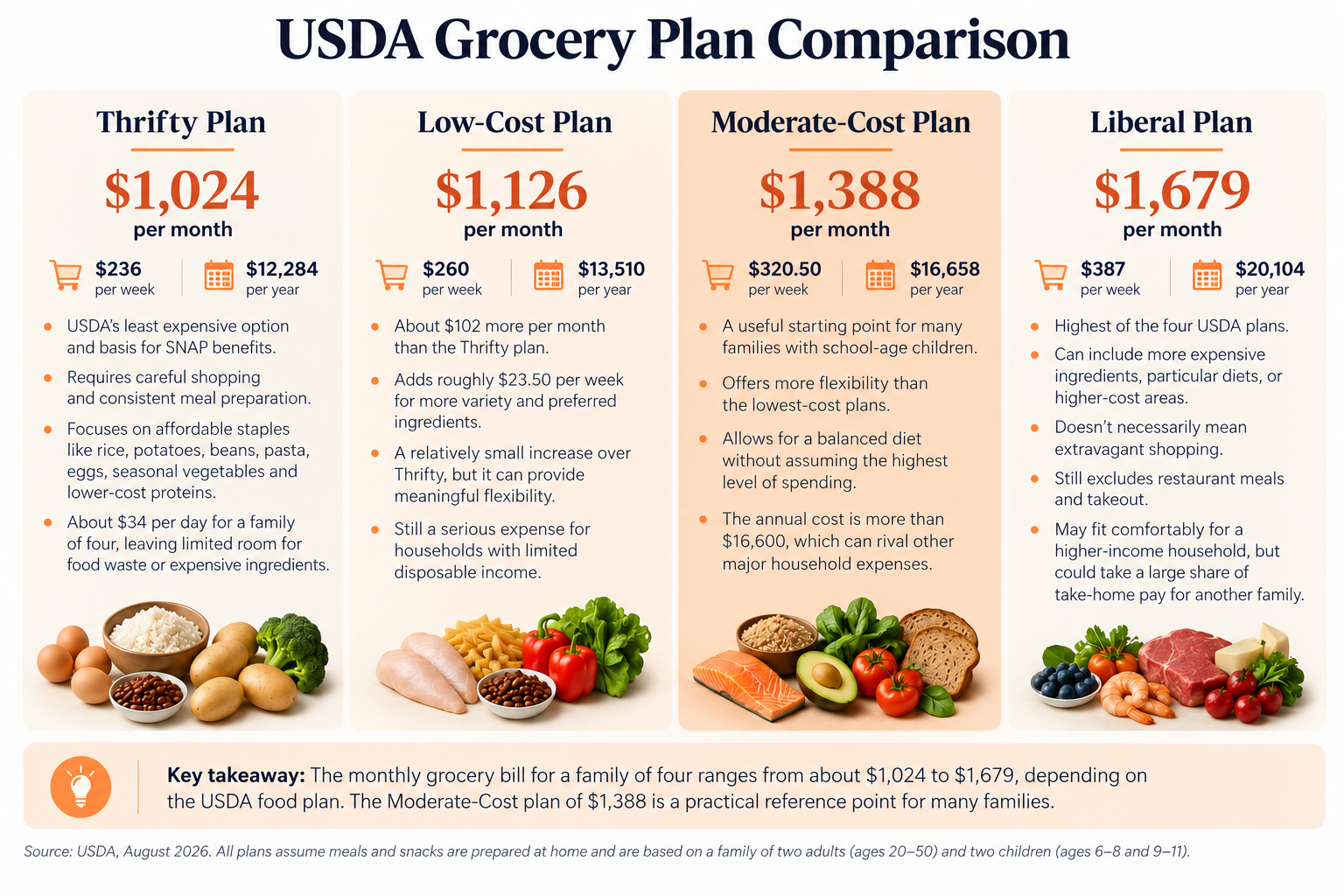
According to the USDA’s August 2026 estimates, feeding two adults and two school-age children costs approximately $1,024 to $1,679 a month, depending on whether the household follows a Thrifty, Low-Cost, Moderate-Cost, or Liberal food plan.
The Moderate-Cost plan comes to about $1,388 a month, or $321 a week. That’s a useful starting point for families trying to establish a realistic grocery budget, although there’s an important distinction to make.
USDA food plans estimate what nutritious meals prepared at home should cost. They don’t measure what the average American family actually spends at the supermarket.
And once we compare those estimates with real household spending, the numbers become considerably more interesting.
Key Takeaways
- The USDA estimates a monthly food-at-home budget of approximately $1,024 to $1,679 for two adults and two school-age children in August 2026.
- The USDA’s Moderate-Cost plan is about $1,388 per month.
- BLS data show four-person consumer units spent about $725 per month on groceries in 2024, plus about $487 on food away from home.
- Children’s ages, food prices, and spending on restaurants all affect the budget that makes sense for a household.
What Is the Average Grocery Bill for a Family of 4 in 2026?
The USDA publishes four monthly food plans covering different spending levels.
Its August 2026 food-cost estimates provide the following grocery budgets for a family consisting of two adults ages 20–50 and two children ages 6–8 and 9–11.
| USDA Food Plan | Average Weekly Grocery Budget | Monthly Grocery Budget |
|---|---|---|
| Thrifty | $236.30 | $1,023.70 |
| Low-Cost | $259.80 | $1,125.80 |
| Moderate-Cost | $320.50 | $1,388.20 |
| Liberal | $387.40 | $1,678.70 |
Source: USDA, August 2026. The Thrifty figure is the published reference-family total. The other figures are calculated from the USDA’s individual food-cost estimates. All plans assume meals and snacks are prepared at home.
The difference between the cheapest and most expensive plans is approximately $655 a month, or $7,860 annually.
That’s a substantial amount of money. It could cover several months of utility bills, contribute to retirement savings, or help build an emergency fund.
However, don’t assume every family spending $1,679 could comfortably reduce its grocery bill to $1,024. Food prices, dietary requirements, children’s ages, and available cooking time all affect what’s realistic.
Average Grocery Bill by USDA Food Plan
All four USDA food plans are designed around nutritionally adequate diets.
The differences involve food selections, quantities, and the overall cost of maintaining those diets.
Thrifty Plan: $1,024 a Month
The Thrifty Food Plan is the USDA’s least expensive option and provides the foundation for calculating maximum SNAP benefits.
At approximately $236 a week, this grocery budget requires careful shopping and consistent meal preparation. Affordable staples such as rice, potatoes, beans, pasta, eggs, seasonal vegetables, and lower-cost proteins become particularly useful.
The main concern with recommending the Thrifty figure as a universal grocery target is the amount of planning it requires.
Feeding four people for approximately $34 a day leaves limited room for food waste, expensive ingredients, or unexpected schedule changes.
Consider it a demanding budget rather than a standard every family should feel obligated to meet.
Low-Cost Plan: $1,126 a Month
The Low-Cost plan increases the monthly grocery allowance by approximately $102, bringing the weekly budget to about $260.
That additional $23.50 a week can make room for more variety, preferred ingredients, or less dependence on the cheapest available foods.
There is a relatively small difference between Thrifty and Low-Cost, interestingly. Moving up one USDA category doesn’t require a dramatic increase in spending, yet the extra money can provide some flexibility.
Still, a grocery bill exceeding $1,100 every month is a serious expense for households with limited disposable income.
Moderate-Cost Plan: $1,388 a Month
The Moderate-Cost plan allows approximately $320.50 a week for groceries.
Of the four USDA estimates, this is the figure you should use as an initial budgeting reference for a family with two school-age children, assuming ordinary dietary needs and no unusually expensive local food prices.
It offers more flexibility than the lowest-cost plans without assuming the highest level of grocery spending.
However, an average monthly grocery bill of $1,388 translates into more than $16,600 annually.
That’s the number you should keep in mind. We tend to treat groceries as a collection of smaller purchases, but their annual cost can rival other major household expenses.
Liberal Plan: $1,679 a Month
The Liberal plan comes to approximately $387 a week, or more than $20,100 annually.
Despite the name, you shouldn’t automatically associate this grocery budget with extravagant shopping.
Families purchasing more expensive ingredients, maintaining particular diets, or living in higher-cost areas can approach this amount without buying luxury foods.
The USDA’s Liberal estimate also excludes restaurant meals and takeout.
For a higher-income household, $1,679 might fit comfortably into the monthly budget. For another family, the same amount could consume an uncomfortable share of take-home pay.
That’s why the income matters more than whether someone’s grocery spending falls into a category labeled Moderate or Liberal.
What Is the Average Grocery Bill Americans Actually Pay?
USDA food plans tell us what groceries are estimated to cost under specific assumptions. Actual household spending tells a different story.
The Bureau of Labor Statistics expenditure data, published through the Federal Reserve Bank of St. Louis, shows that four-person consumer units spent an average of $8,697 on food at home in 2024.
That’s approximately $725 a month on groceries.

However, those same households spent another $5,847 annually on food away from home.
| Food Spending Category | 2024 Monthly Average |
|---|---|
| Groceries and food at home | $725 |
| Restaurants and food away from home | $487 |
| Total food spending | $1,212 |
What stands out is the additional $487 a month spent outside the home.
Someone comparing only supermarket receipts could conclude that the average grocery bill is considerably lower than USDA estimates suggest.
But a substantial portion of household food spending goes toward restaurants, takeout, and other prepared meals.
The shift is even more striking at the national level. According to USDA data, more than half of U.S. food spending now goes toward meals prepared away from home, although that broader measure should not be confused with individual household spending.
There are also important differences between these datasets.
The BLS figures represent actual spending by four-person consumer units with different household compositions.
They’re also from 2024, whereas the USDA estimates reflect August 2026 prices and a specific family structure.
You shouldn’t treat the two figures as competing answers to exactly the same question.
One measures spending behavior; the other models food costs under particular nutritional and preparation assumptions.
How Children’s Ages Affect the Average Grocery Bill
One problem with discussing the average grocery bill for a family of four is that four people can have very different nutritional requirements.
A household with two preschoolers isn’t going to consume the same amount of food as one with two teenagers.
Using the USDA’s August 2026 Moderate-Cost estimates, two adults with children ages 2–3 and 4–5 would need approximately $1,163 a month.
Replace those children with a teenage boy and girl ages 14–19, and the estimated monthly grocery bill rises to approximately $1,461.
That’s nearly $300 more each month without adding another person to the household.
This comparison is particularly useful because it identifies a budget increase that doesn’t necessarily result from inflation or poor shopping habits.
Children grow, their nutritional needs change, and the household buys more food. A family can shop at the same supermarket and choose similar products yet still see its grocery expenses rise considerably over time.
Household size also changes the calculation. Our article on monthly grocery costs for one person explores how smaller households face different challenges, particularly with package sizes and food waste.
How Grocery Inflation Affects the Average Monthly Grocery Bill
The USDA reported that food-at-home prices were 2.2% higher in August 2026 than a year earlier.
Its September Food Price Outlook projected a 2.4% increase in average grocery prices for 2026, far below the 11.4% increase recorded in 2022.
Still, families have good reason to remain concerned about the accumulated increases.
Lower inflation means prices are rising more slowly. It doesn’t erase the increases households have already absorbed.
Individual food categories also behave differently. The USDA projected beef and veal prices would rise 9.4% in 2026, even as egg prices were expected to decline substantially, according to its Food Price Outlook.
A family buying beef regularly could therefore experience a different grocery inflation rate from one relying more heavily on chicken, beans, and eggs.
National inflation figures tell us how prices are moving overall. They don’t necessarily explain what’s happening to your particular grocery bill.
How Much Should a Family of Four Budget for Groceries?
Rather than choosing the lowest USDA food plan automatically, start with a realistic estimate and compare it with actual household spending.
Real-Life Grocery Budgeting
Tracking actual household expenses can help families build a grocery budget based on their own spending habits.
Real-Life Grocery Budgeting
See how one family tracks its monthly expenses and why comparing planned spending with actual costs can help build a more realistic household budget.
Video: Debt Free Millennials / YouTube
For two adults and two school-age children, the Moderate-Cost estimate of approximately $1,388 a month provides a useful reference point. Then, make a few practical adjustments.
- Separate groceries from household supplies. Cleaning products, detergent, toilet paper, and toiletries shouldn’t inflate the food budget.
- Track restaurant spending separately. A lower supermarket bill doesn’t necessarily mean lower food expenses if takeout spending increases.
- Pay attention to food waste. Throwing away $15 worth of groceries every week adds up to $780 annually.
- Compare unit prices. Larger packages save money only when the household actually uses everything.
- Review two or three months of spending. One unusually expensive grocery trip shouldn’t determine the household’s entire budget.
You should also compare the monthly grocery bill with take-home income.
For a family bringing home $6,000 a month after taxes, spending $1,388 on groceries consumes approximately 23% of disposable income.
That’s a significant commitment before housing, transportation, healthcare, or childcare enters the picture.
If a family consistently spends $1,500 while eating well and wasting little, an honest $1,500 budget makes more sense than an unrealistic $1,100 target that gets exceeded every month.
The purpose of a grocery budget is to manage household spending, not to make the numbers look impressive on paper.
What Is a Reasonable Average Grocery Bill for a Family of Four?
Based on the USDA’s August 2026 estimates, a reasonable monthly grocery budget for two adults and two school-age children ranges from approximately $1,024 on the Thrifty plan to $1,679 on the Liberal plan.
Start around $1,400 for a family preparing most meals at home, then adjust for children’s ages, location, dietary needs, and actual spending habits.
But the number you should pay closest attention to isn’t the national average grocery bill or which USDA category your family falls into.
It’s the relationship between grocery spending and the rest of your household budget.
A cheaper grocery bill isn’t automatically a better one. Saving $100 by purchasing food nobody wants to eat, or by relying more heavily on expensive takeout, doesn’t improve the family’s finances.
The most useful grocery budget is one that feeds your family well, reflects what you actually spend, and leaves enough money for everything else.