

American households plan to spend an average of $285 on Halloween in 2026, according to a new Deloitte survey.
Of that amount, $219 will go toward retail purchases, with another $66 spent on experiences, events, and dining.
The Deloitte Halloween Survey, conducted among 1,500 U.S. households in August, also found that 34% of consumers expect to spend more than they did last year.
What stands out is how many different purchases now fit into a holiday that technically lasts one night.
Costumes and candy are still central to Halloween, but decorations, attractions, parties, and restaurant visits have become part of the budget.
And once spending gets spread across several weeks, I think it becomes much harder for households to recognize how much they’re actually spending.
Key Takeaways
- $285 per household: Deloitte’s projected average Halloween spending in 2026.
- $219 for retail: Most planned spending goes toward purchases rather than experiences.
- $13.5 billion: The National Retail Federation’s projection for total U.S. Halloween spending.
- Financing concerns: Approximately one in five Halloween shoppers plans to use financing for purchases.
Where the $285 Halloween Budget Goes
Deloitte estimates that households will divide their Halloween spending into two broad categories.
| Spending category | Average household spending |
|---|---|
| Retail purchases | $219 |
| Experiences, activities, and dining | $66 |
| Total | $285 |
Where Halloween Spending Goes
Average projected spending per U.S. household in 2026.
Share of the $285 projected household total. Source: Deloitte Halloween Survey, 2026.
Retail purchases represent roughly 77% of the total, leaving 23% for experiences.
A closer look at individual categories reveals where the money goes. Households plan to spend an average of $57 on costumes and accessories, $54 on decorations, and $48 on candy, food, and beverages. Dining and social outings account for another $32.
The decoration figure is particularly interesting.
The Spending PerspectiveHouseholds are planning to spend almost as much on Halloween decorations as they are on costumes.
Unlike costumes, decorations can theoretically last for years. Yet Halloween has developed a strong seasonal shopping culture, with new decorations appearing in stores well before October.
From a household-budget perspective, spending $80 on decorations that last five years is a better financial decision than spending $40 every October to replace inexpensive items.
The purchase price matters, but how long something remains useful matters just as much.
The Average Doesn’t Tell Us What a Typical Family Spends
Still, you shouldn’t interpret $285 as the amount every American household needs to celebrate Halloween.
Deloitte’s survey included households with no planned Halloween spending. It also covered families organizing several activities and households planning more modest celebrations.
The average blends all those situations into one figure.
The median would be a more useful measure of what a typical household expects to spend. However, Deloitte’s published summary does not provide that figure.
Children Make a Noticeable Difference

The survey found that 92% of households plan to participate in at least one Halloween activity.
Households with children expect to participate in six activities, compared with four among households without children.
That difference deserves attention.
For a family with two children, Halloween can involve school celebrations, costumes, neighborhood trick-or-treating, pumpkin carving, decorations, and a weekend attraction.
A couple planning to watch a scary movie and hand out candy faces a completely different calculation.
The number of activities a household participates in can matter as much as the price of any individual purchase.
There’s also an affordability question. Deloitte found that 71% of Halloween spenders say they can comfortably afford their planned celebrations.
That’s encouraging, but it also means nearly three in ten didn’t report the same level of comfort.
Don’t assume everyone spending $285 has $285 sitting comfortably outside their regular household expenses.
Halloween Has Become a Longer Shopping Season
One of the more revealing findings comes from the National Retail Federation.
According to its 2026 Halloween consumer survey, 49% of consumers begin Halloween shopping in September or earlier.
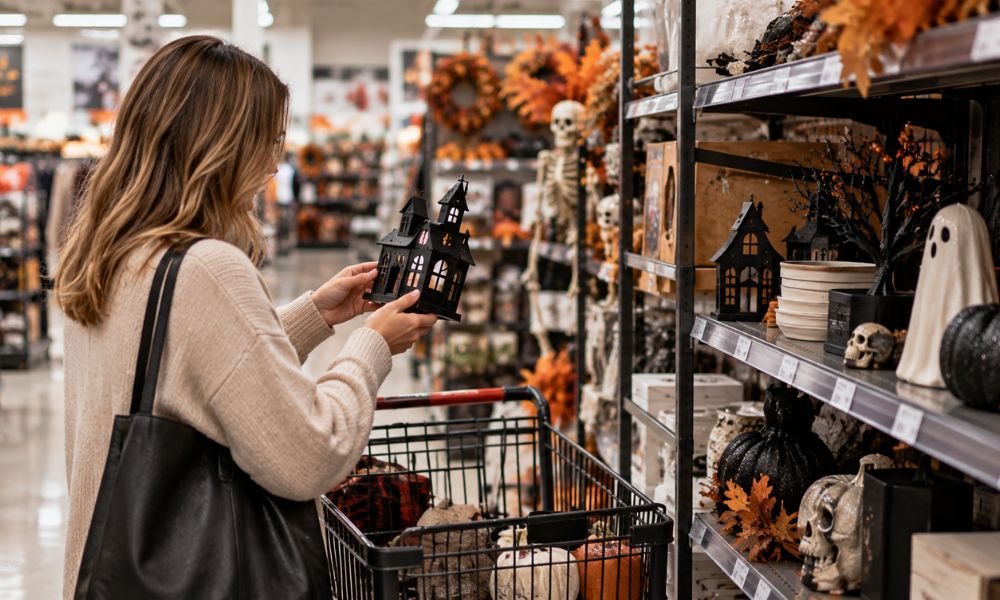
In 2016, that figure was 34%. Halloween shopping has moved considerably further into the calendar.
Deloitte also found that consumers who started shopping before mid-August planned to spend 1.7 times as much as late shoppers.
You should be careful about interpreting that as evidence that shopping early causes higher spending.
People who start buying Halloween decorations in August are probably more enthusiastic about the holiday to begin with.
They’re also more likely to organize parties, decorate extensively, and participate in multiple activities.
Still, a longer shopping season creates more opportunities to spend.
Someone might buy decorations in August, costumes in September, and candy in October. Each purchase feels relatively manageable because it happens separately.
Only when everything is added together does the full cost become obvious.
That’s why early shopping is useful for a household budget only when there’s already a spending limit. Spreading purchases across three months doesn’t make them cheaper if the total keeps growing.
Americans Will Spend $13.5 Billion on Halloween
The National Retail Federation expects total U.S. Halloween spending to reach $13.5 billion in 2026, compared with the record $13.1 billion in 2025.
Its spending projections include:
| Category | Expected U.S. spending |
|---|---|
| Costumes | $4.4 billion |
| Decorations | $4.3 billion |
| Candy | $4.1 billion |
| Greeting cards | $800 million |
Projected Halloween Spending by Category
Estimated U.S. spending in billions of dollars.
Bar lengths are scaled relative to costume spending. Source: National Retail Federation, 2026. Figures are rounded estimates.
Costumes remain the largest category, narrowly ahead of decorations. And costume spending now extends well beyond adults and children.
As we explored in our article about Americans spending $920 million on pet costumes, dressing animals for Halloween has become a substantial retail category in its own right.
It’s a good example of how a holiday budget expands without any individual purchase looking especially extravagant.
A $20 costume for the dog doesn’t feel like a major financial decision. Neither does another $25 decoration or an extra bag of candy. Together, those additions can change the household total significantly.
Why Another Survey Says $115 Per Person
NRF estimates that consumers will spend an average of $115.14 per person this Halloween, compared with $114.45 in 2025.
That might seem inconsistent with Deloitte’s $285 figure, but the two surveys measure spending differently.
Deloitte reports household spending across shopping and experiences. NRF reports spending per person using its own survey methodology.
You shouldn’t directly compare them or use one to calculate how much a particular family should spend.
What both surveys show is that Americans continue to devote substantial money to Halloween, even as many shoppers pay close attention to prices.
One in Five Halloween Shoppers Plan to Use Financing
Of all the findings, this is the one that concerns me most. According to Retail Dive’s reporting on Deloitte’s survey, approximately one in five Halloween shoppers plans to use buy now, pay later services or other financing to cover purchases.
Financing doesn’t automatically mean someone cannot afford an expense. Some consumers use installment payments for convenience or cash-flow management.
But borrowing for costumes, candy, and decorations deserves a closer look. Consider a household financing $285 through a four-payment plan. That works out to $71.25 per installment.
The purchase hasn’t become cheaper. The household has simply moved part of its Halloween spending into future pay periods.
The Consumer Financial Protection Bureau warns that many buy now, pay later loans charge late fees when borrowers miss payments, even when the original financing carries no interest.
One of the concerns we hear often is that a temporary celebration can become a financial obligation after the decorations have been packed away.
You should be particularly cautious about borrowing for Halloween because Thanksgiving and Christmas arrive shortly afterward. October spending rarely happens in isolation from the rest of the holiday season.
How Much Should a Household Actually Budget for Halloween?
We don’t think $285 should become anyone’s spending target simply because it’s the national average.
The better question is what kind of Halloween the household wants and how much it can comfortably spend.
A $200 budget, for example, could look like this:
Example: A $200 Halloween Budget
- $50 for costumes: Reuse existing accessories and buy only what’s missing.
- $50 for candy and food: Set a limit before shopping.
- $25 for decorations: Use existing decorations before buying anything new.
- $45 for activities: Choose one paid event alongside free celebrations.
- $30 for unexpected expenses: Keep a small buffer for last-minute purchases.
$200
That totals $200, or $85 less than Deloitte’s projected average.
This approach is very good because it doesn’t require eliminating the activities that make Halloween enjoyable. It simply forces the household to decide which purchases matter.
Watch the Expenses That Don’t Feel Like Halloween Spending
There’s another consideration that gets overlooked. Restaurant meals, transportation to attractions, parking, and snacks purchased during outings can blend into ordinary household spending.
A family might remember spending $75 on costumes and $40 on candy, then forget the $65 dinner after visiting a pumpkin patch. Financially, that dinner is still part of the celebration.
And the timing matters. For families traveling over Thanksgiving, our breakdown of holiday flights for a family of four shows how quickly the next major seasonal expense can arrive.
Look at Halloween as part of the larger October-through-December household budget rather than treating it as an entirely separate financial event.
The Real Cost Depends on How Much Halloween You Celebrate
The $285 estimate tells us something interesting about the way Americans celebrate Halloween in 2026.
Halloween has become a collection of purchases and experiences spread across several weeks. That helps explain why spending can reach hundreds of dollars without any single transaction feeling especially expensive.
There’s nothing inherently unreasonable about spending $285 on a holiday that brings a family genuine enjoyment, provided the money is available.
What is concerning, though, is spending that happens almost automatically, especially when households are already managing higher everyday costs and approaching the expensive end-of-year holiday season.
The Bottom LineThe number I would pay attention to isn’t the national average. It’s the difference between what your household planned to spend and what it actually spent.
A $150 Halloween that turns into $300 is worth examining. A deliberately budgeted $300 celebration that stays within the household’s means is a different story.
That’s the most useful distinction in Deloitte’s numbers. Halloween doesn’t have to be cheap to be financially reasonable. It does, however, deserve an actual place in the household budget.
Sources & Methodology
This article examines projected Halloween spending in 2026 using published consumer survey findings and reporting from multiple sources.
Deloitte Halloween Survey: The household spending estimates come from Deloitte’s survey of 1,500 U.S. households conducted in August 2026. The reported $285 is an average, not a median or a recommended spending amount.
National Retail Federation: The $13.5 billion projection and national spending categories come from NRF’s 2026 Halloween consumer survey. NRF’s per-person spending estimate uses a different methodology from Deloitte’s household figure.
Consumer borrowing: Financing-related findings are attributed to Retail Dive’s reporting on the Deloitte survey. Consumer information about buy now, pay later fees comes from the Consumer Financial Protection Bureau.
The $200 household budget is an illustrative example created for this article. It is not a survey result or a recommendation from Deloitte or NRF.
The author’s interpretations and budgeting observations are presented separately from the reported survey statistics.