

A couple can expect a range of approximately $630 to $1,007, while one adult’s costs can start around $300 per month.
Those figures come from the USDA’s monthly food cost reports, using August 2026 prices.
The most interesting part of these numbers is how household size changes the calculation. Feeding four people doesn’t necessarily cost twice as much as feeding two.
Buying larger quantities, sharing ingredients, and reducing waste can bring the cost per person down.
There’s also an important difference between what Americans actually spend on groceries and what the USDA estimates a nutritious diet should cost. Both figures are useful, but they answer different questions.
Average Monthly Grocery Cost by Household Size in 2026
The USDA publishes four monthly food budgets, ranging from its economical Thrifty Food Plan to the more generous Liberal Food Plan.
Here is what those budgets look like for households with one to six people.
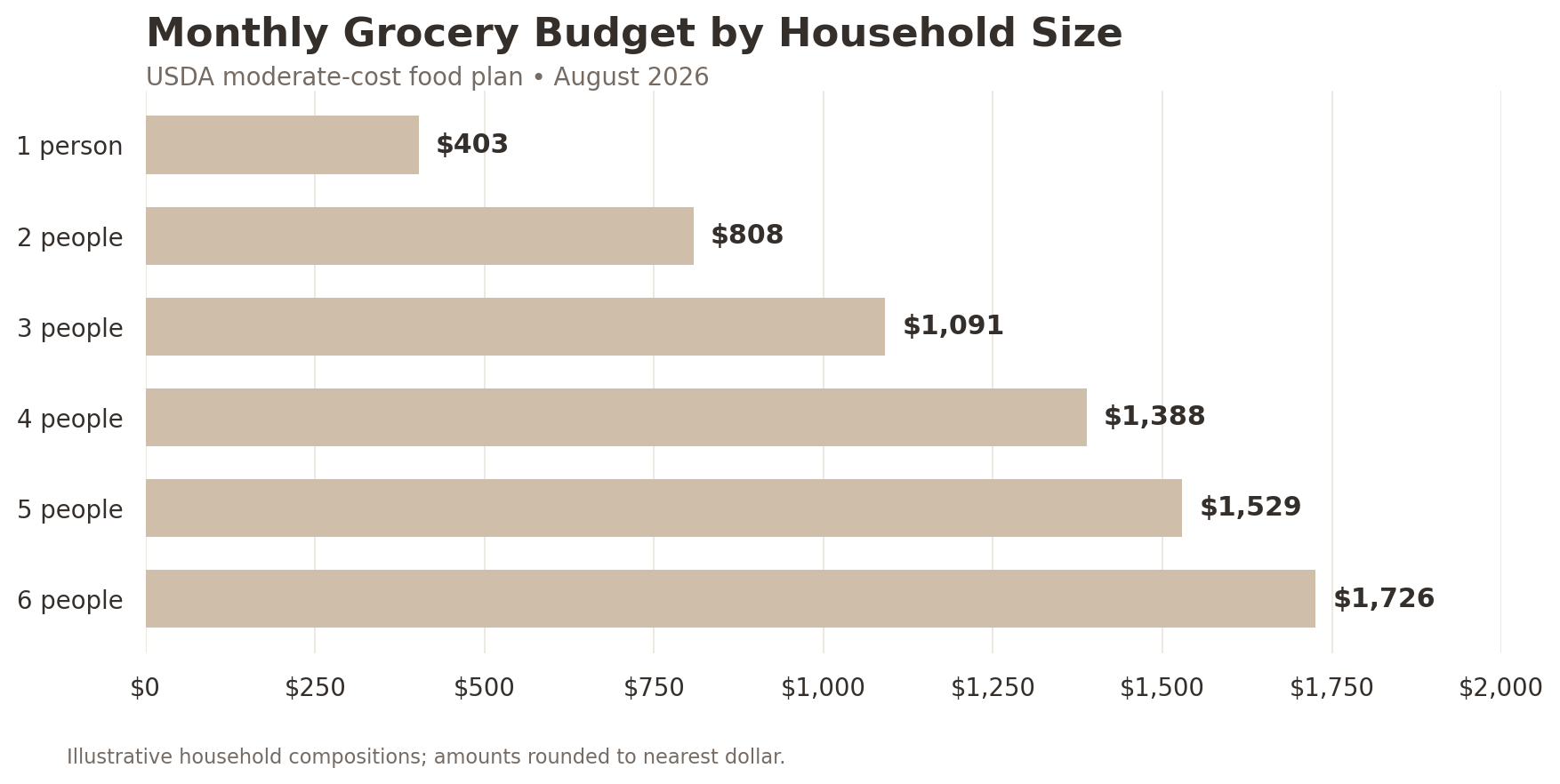
Source: My calculations using USDA August 2026 food-plan costs, rounded to the nearest dollar. These are illustrative household budgets, not observed national averages.
The one-person example uses a woman aged 20–50. The two-person household adds a man of the same age.
The three-person household adds a child aged 6–8, and the four-person household adds a child aged 9–11. The five- and six-person households add children aged 4–5 and 2–3, respectively.
Different ages and household compositions produce different totals.
For most readers, you should start with the moderate-cost column. It provides a useful middle benchmark without assuming either the tightest possible food budget or the most expensive grocery choices.
How the USDA Calculates Household Food Costs
The USDA estimates grocery costs for individuals according to their age and sex, then adjusts the combined amount for household size.
Its adjustment rules are:
- One person: add 20%.
- Two people: add 10%.
- Three people: add 5%.
- Four people: no adjustment.
- Five or six people: subtract 5%.
- Seven or more people: subtract 10%.
The adjustment accounts for economies of scale in food purchasing and preparation.
Use the calculator below to see how the USDA household-size adjustment changes your combined monthly food-plan estimate.
Household Food Cost Calculator
See how USDA household-size adjustments affect your estimated monthly food costs.
1 person
Enter the total of individual USDA food-plan estimates for your household.
Base monthly cost: $400.00
USDA adjustment: +20%
Adjustment amount: +$80.00
ADJUSTED MONTHLY FOOD COST
The USDA adds 20% to the individual food-plan estimate for a one-person household.
Note: This calculator applies USDA household-size adjustments only. Enter the combined individual USDA food-plan costs, not your actual grocery spending.
This is particularly important for single-person households.
Buying groceries for one can be surprisingly expensive per person because smaller packages cost more per serving, and fresh ingredients can spoil before they’re finished.
What Do Americans Actually Spend on Groceries?
The USDA provides useful budgets, but the Bureau of Labor Statistics measures something different: actual household spending.
According to the BLS Consumer Expenditure Surveys, American consumer units spent an average of $6,224 on food at home in 2024, equivalent to approximately $519 per month.
That is the latest published annual expenditure estimate available as of October 2026.
The averages also change considerably with household size.
Source: BLS Consumer Expenditure Surveys, 2024, size-of-consumer-unit tables. Monthly amounts are annual expenditure averages divided by 12 and rounded.
A four-person household’s observed average of $725 is considerably below the USDA’s 2026 moderate-cost estimate of $1,388.
You shouldn’t interpret that difference as proof that the USDA’s budget is excessive.
The figures come from different years and measure different things. BLS records actual purchasing behavior across a broad range of households, including families that buy substantial amounts of restaurant food. The USDA prices specific nutritious food plans assuming meals and snacks are prepared at home.
For that reason, actual spending is useful for comparison, while USDA food plans are more useful for building a grocery budget.
There is also a bigger shift happening beyond household grocery budgets. Our analysis of U.S. spending on food away from home shows how restaurants and other foodservice establishments have come to account for the majority of national food expenditures.
How Much Should One Person Spend on Groceries?
A single adult woman aged 20–50 has a USDA moderate-cost grocery budget of approximately $403 per month. For a man of the same age, that figure increases to approximately $478.
That difference reflects the USDA’s separate food requirements for different demographic groups.
For someone living alone, $400 per month works out to about $92 per week.

The biggest challenge for single-person households is making the groceries they purchase last long enough to use them.
A large bag of produce can look economical at checkout. If half of it ends up in the trash, the smaller package would have been the better financial decision.
For retirees, the calculation becomes especially important because groceries compete with housing, healthcare, and other expenses on a fixed income.
Our discussion of Social Security’s projected monthly increase explains why even relatively small changes in recurring expenses matter.
Average Grocery Cost for Two People
Two adults aged 20–50 have a combined USDA grocery budget of approximately $808 per month on the moderate-cost plan.
That’s around $187 per week, or $404 per person monthly.
What’s interesting is that the per-person budget is similar to the single-woman estimate, despite the household-size savings.
The reason is that the two-person calculation includes an adult man with a higher individual food-cost estimate.
You should also distinguish between two adults who cook most meals together and two roommates who maintain separate groceries.
Sharing ingredients, buying family-sized packages, and preparing meals together can reduce duplication. Separate shopping habits can eliminate much of that advantage.
Monthly Grocery Cost for a Family of Three
A household with two adults and one child aged 6–8 needs approximately $1,091 per month under the USDA moderate-cost plan.
That comes to about $252 per week.
Adding a child changes food expenses in ways that go beyond purchasing another portion at dinner.
Packed lunches, snacks, breakfast foods, and individual preferences create additional grocery purchases.
What stands out is how easily small purchases become a significant monthly expense.
An extra $25 per week in snacks and convenience foods amounts to roughly $108 per month over a full year.
That is enough to make a noticeable difference between two otherwise similar household grocery budgets.
Average Grocery Bill for a Family of Four

For the USDA’s reference family of four, two adults and two school-age children, the monthly costs are:
A moderate grocery budget of $1,388 represents approximately $16,658 annually.
The annual number deserves attention.
We tend to evaluate groceries one shopping trip at a time. A $180 supermarket receipt gets our attention immediately, but the total annual expense is much easier to underestimate.
For perspective, our analysis of new-car ownership costs discusses a 2026 AAA estimate exceeding $12,800 annually.
A family’s grocery budget can therefore exceed the annual ownership cost of a new vehicle.
That comparison gives a much clearer picture of how important food expenses are to household finances.
Grocery Costs for Families of Five or Six
Using the household examples from the first table, a family of five has a moderate monthly grocery budget of approximately $1,529.
For six people, the figure reaches $1,726.
Larger households benefit from purchasing efficiencies, but they still need to budget for the individual food requirements of everyone living there.
Pay particular attention to children’s ages.
A household with four young children can have substantially different food expenses from one with four teenagers.
The number of people matters, but their ages and eating habits determine how much food the household actually needs.
Children’s Ages Can Change the Grocery Budget Dramatically
The USDA’s August 2026 moderate-cost plan estimates the following monthly food costs for children living in a four-person household.
These are individual base costs before adjustments for a household size other than four.
A teenage boy’s estimated monthly food cost is nearly twice that of a child aged 2–3.
This helps explain something parents can easily overlook.
A grocery bill can increase even when household size stays exactly the same.
Children grow, portions get larger, and food preferences change. Grocery inflation isn’t necessarily responsible for every increase in a family’s food spending.
Why Grocery Bills Still Feel Expensive in 2026
Food inflation has slowed considerably from the extraordinary increases Americans experienced earlier in the decade.
According to the USDA’s September 2026 Food Price Outlook, grocery prices were 2.2% higher in August 2026 than a year earlier.
The agency forecasts a 2.4% increase in average food-at-home prices for 2026.
That is much slower than the 11.4% grocery price increase recorded in 2022.
However, slower inflation doesn’t mean groceries have returned to their old prices.
This distinction explains much of the frustration surrounding grocery spending.
A family that was comfortable with a $700 grocery budget several years ago can face a much larger bill today, even after the pace of price increases has slowed.
Individual Food Prices Tell Different Stories
Not every grocery category is increasing at the same rate.
In its September outlook, the USDA projected a 9.4% increase in beef and veal prices for 2026, compared with a 1.0% increase for poultry.
Egg prices, meanwhile, were forecast to decline substantially from their elevated 2025 levels.
A household buying beef several times a week will experience grocery inflation differently from one relying more heavily on chicken, beans, or other proteins.
That’s why you should examine which products are driving a personal grocery bill higher rather than assuming every item is becoming more expensive at the same pace.
How Much of Your Income Should Go Toward Groceries?
There isn’t a single grocery-budget percentage that works for every household.
Income, family size, location, dietary requirements, and restaurant spending all matter.
Location also affects how far a household budget stretches. Our analysis of California purchasing power shows why the same amount of money can support very different living standards across U.S. states.
The USDA reports that Americans spent approximately 4.8% of disposable personal income on food at home in 2025, based on national food expenditure data.
That figure is useful for understanding the economy, but treating it as a household spending limit is not a wise move.
Consider a family earning $80,000 annually before taxes.
The USDA’s $1,388 moderate grocery budget represents roughly 20.8% of that family’s gross monthly income.
A household earning $160,000 would devote about 10.4% of gross income to the same grocery budget.
Neither percentage tells the full story without considering taxes, housing, childcare, transportation, and other commitments.
Choose a realistic grocery dollar amount first, then evaluate whether the total household budget can support it.
How to Build a Monthly Grocery Budget That Works
Building grocery budgets around actual spending rather than choosing an arbitrary target is a smart move.
Start by reviewing two or three months of grocery transactions.
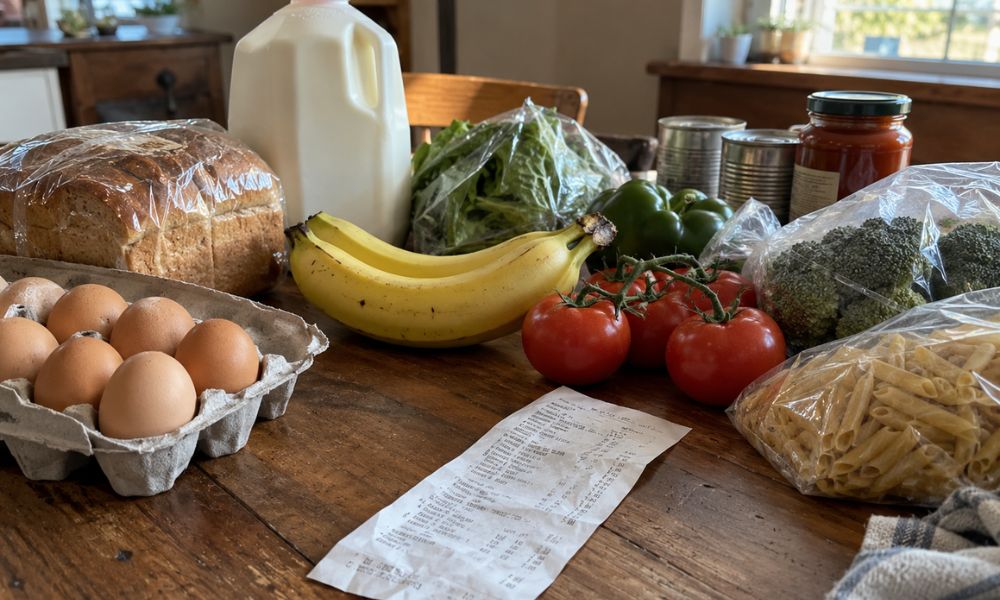
Then separate food purchases from household items such as cleaning supplies, toiletries, paper products, and pet food.
Those products can make a supermarket receipt significantly larger without increasing the amount spent on groceries.
Next, compare your actual spending with the USDA budget for your household’s composition.
If you’re spending considerably more, examine what’s driving the difference before deciding how much to reduce.
Where You Should Look for Savings First
Priorities should be:
- Food waste. Reduce purchases that regularly spoil before being used.
- Convenience foods. Compare prepared meals, pre-cut produce, and individual portions against less expensive alternatives.
- Repeated purchases. Check whether ingredients are being purchased when similar products are already available at home.
- Price per unit. Compare ounces, pounds, or servings instead of package prices alone.
- Meal planning. Plan several meals around overlapping ingredients so purchases are actually used.
We wouldn’t automatically recommend cutting fresh produce or buying the cheapest possible food.
A grocery budget should still support a nutritious diet.
The point is to spend less on products that aren’t delivering much value.
FAQs
The Grocery Number I Would Actually Use
For a family of four, start with the USDA’s approximately $1,388 monthly moderate-cost estimate, then compare it with what that particular family actually buys and eats.
For smaller or larger households, make the same comparison using the corresponding USDA figures.
The goal shouldn’t be to spend less than the national average simply to prove that you can.
A household spending $900 a month on groceries isn’t automatically managing its money better than one spending $1,200.
The more useful question is whether that money is providing nutritious meals, fitting comfortably alongside other household expenses, and avoiding unnecessary waste.
That’s the grocery number worth paying attention to.