

A reasonable grocery budget for one person in 2026 is about $300 to $500 a month, with roughly $350 to $450 being a useful starting range for many adults who cook most of their meals at home.
You can certainly spend less. You can also blow past $500 without filling your cart with lobster and imported cheese.
What most people want to know about grocery budgets is how misleading a single “average” can be. Someone spending $300 a month and someone spending $500 can both have perfectly ordinary food habits.
Age, sex, location, how much you cook, what you eat, and how frequently you order food all change the calculation.
There is also a surprisingly important financial disadvantage to shopping for one. You do not get the same economies of scale as a family buying larger packages and actually finishing them.
A One-Person Grocery Budget Can Range From About $300 to $580
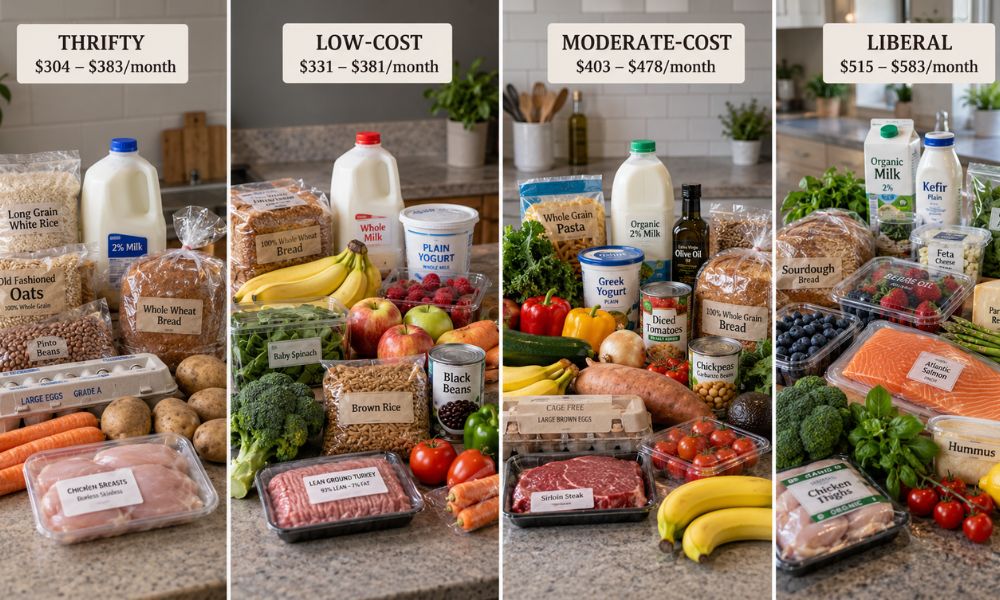
The USDA publishes monthly estimates for four food plans ranging from Thrifty to Liberal.
Its August 2026 figures provide one of the better benchmarks for answering this question because they are built around food intended to be prepared and eaten at home.
There is one adjustment that is especially important here. The headline USDA amounts for individuals assume they are part of a four-person household.
For someone living alone, the USDA recommends adding 20% to account for the higher cost of feeding a one-person household, according to its monthly food plan reports.
After applying that adjustment, the estimates for adults ages 20 to 50 look roughly like this:
| USDA food plan | Woman living alone | Man living alone |
|---|---|---|
| Thrifty | $304/month | $383/month |
| Low-Cost | $331/month | $381/month |
| Moderate-Cost | $403/month | $478/month |
| Liberal | $515/month | $583/month |
There’s no need to read much into a difference of two dollars. USDA reevaluated the Thrifty Food Plan in 2021, whereas the other three plans still use an older underlying market basket that is updated for current prices. They are useful benchmarks, not four perfectly aligned rungs on a grocery ladder.
The larger point is much clearer. Around $300 is genuinely frugal territory for one adult. Around $400 is a solid middle-of-the-road food-at-home budget. Spending $500 or more is hardly unusual once higher-cost foods, convenience, dietary preferences, or expensive local prices enter the cart.
Americans Living Alone Actually Spend About $283 a Month at Home
Actual spending data gives us another useful perspective.
According to Bureau of Labor Statistics Consumer Expenditure Survey data available through the Federal Reserve Bank of St. Louis, a one-person consumer unit spent an average of $3,395 on food at home in 2024. That works out to about $283 a month.
The same one-person households spent another $2,249 annually on food away from home, or about $187 a month. Total food spending therefore came to roughly $470 a month, according to the one-person spending data.
The split matters much more than the $283 grocery figure by itself.
The USDA plans assume meals and snacks are prepared at home. Real people do not behave that way. We get lunch at work, order pizza, buy coffee, meet friends for dinner, and occasionally discover at 8 p.m. that the carefully purchased ingredients in the refrigerator have lost to a burrito.

Someone spending $285 at the supermarket is not necessarily feeding themselves for $285. Their actual food budget could easily be $450 or $500 once restaurants and takeout are included.
This distinction becomes even more important when looking at the national picture. In 2025, food prepared away from home accounted for 56.3% of total U.S. food spending, illustrating just how significant restaurants and other prepared-food purchases have become in the broader economy.
Living Alone Makes Food More Expensive Per Person
The USDA’s 20% adjustment for a one-person household is probably our favorite detail in the data because it reflects something anyone who has shopped alone eventually notices.
Family-size packages usually have lower unit prices. A couple can split a loaf of bread, a bag of spinach, a gallon of milk, or a package of chicken before it goes bad. One person has to eat the same thing repeatedly, freeze it, or accept some waste.
Pantry basics create another problem. Olive oil, flour, spices, condiments, coffee, and similar staples last for weeks or months, yet replacing several of them in one grocery run can make that month’s spending look terrible.
Buying for one therefore does not mean taking a four-person food bill and dividing it by four. Our breakdown of the average grocery cost per month shows how food budgets change across households of different sizes, using USDA estimates and actual consumer spending data.
That is one reason a $350 monthly grocery target can feel surprisingly tight. It sounds like a decent amount of money until you translate it into about $81 per week.
A $400 budget gives you roughly $92 a week. At $500 a month, you have around $115 a week. Suddenly the difference between the budgets feels much more tangible.
Grocery Prices Are Still Rising
Food inflation has slowed considerably from the spikes Americans experienced earlier in the decade, though prices have not returned to their old levels.
BLS data for August 2026 showed that food-at-home prices were 2.2% higher than a year earlier. Restaurant and other food-away-from-home prices were up 3.4%, according to the latest Consumer Price Index release.
The cumulative effect is what bothers shoppers more than the latest inflation rate.
A 2.2% annual increase does not sound dramatic. Your grocery bill, however, is starting from a price level that already absorbed several years of increases. Lower inflation means prices are rising more slowly. It does not mean the checkout screen magically returns to 2019.
For many Americans, rising grocery costs are most noticeable in everyday purchases. Beef and coffee are two products that can make a routine shopping trip feel more expensive. This video highlights the growing concern over how much households are paying for groceries each month.
View this post on Instagram
Groceries are one reason we prefer looking at recurring monthly expenses when thinking about someone’s broader cost-of-living budget. A $20 increase seems minor until it happens every month. Then it becomes $240 a year that has to come from somewhere else.
What Pushes a One-Person Grocery Bill Higher?
A few choices can move the number surprisingly quickly.
- Protein choices matter. Frequent steak, seafood, premium deli meat, or specialty protein products will produce a very different budget from beans, eggs, chicken, lentils, and occasional meat.
- Convenience has a price. Pre-cut fruit, individual snack packs, prepared meals, bottled drinks, and ready-to-eat foods save time, which is exactly why stores can charge more for them.
- Dietary restrictions can raise costs. Gluten-free replacements, specialty products, and certain plant-based substitutes can add noticeably to a monthly total.
- Where you shop matters. Store brands and discount grocers can stretch the same budget much further than premium supermarkets.
- Waste matters more for one person. Buying the cheapest price per ounce does not save money if one-third of the package ends up in the trash.
- Location changes the answer. A national grocery figure cannot fully describe what someone pays in every city or state.
It’s wise to pay especially close attention to waste. People naturally focus on coupons and sale prices because those savings are visible. Throwing away $8 of produce every week is more than $400 a year, and there is no receipt showing you the loss.
Your Grocery-Store Receipt Is Not Necessarily Your Grocery Budget
Another small distinction causes a surprising amount of confusion.
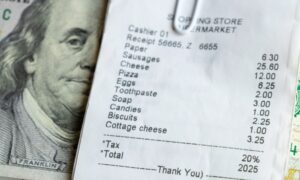
A supermarket receipt can include laundry detergent, shampoo, toilet paper, cleaning products, pet food, aluminum foil, batteries, and half a dozen other things that are not food.
If you spend $450 at grocery stores every month, that does not necessarily mean you eat $450 worth of groceries.
For budgeting, it’s wise to separate food from household supplies. It gives you a much cleaner picture of what is actually changing.
If the food category jumps from $350 to $430, you have something useful to investigate. If a combined “Walmart/Target/grocery” category jumps, you may simply have bought detergent, paper towels, and a new frying pan in the same week.
Good budgeting data should answer a question, not merely reproduce your bank statement.
Is $300 a Month Enough for Groceries?
Yes, though you should consider $300 a fairly tight grocery budget for one adult in 2026.
The USDA’s adjusted Thrifty estimate for a woman ages 20 to 50 is just over $300. The corresponding estimate for a man is closer to $383.
Keeping spending near $300 will usually require cooking regularly, choosing lower-cost proteins, using leftovers, limiting expensive convenience foods, and paying attention to waste.
What does grocery shopping on a $300 monthly budget actually look like? In this video, Michela Allocca walks through her approach to meal planning, checking what she already has in the pantry, and shopping at Aldi while living alone. It’s a practical example of how careful planning and cooking at home can help keep grocery costs down.
Do not automatically call a $500 grocery bill excessive, either.
For someone cooking nearly every meal at home, buying a lot of fresh produce and protein, living in an expensive area, or choosing premium ingredients, $500 can be entirely plausible.
The USDA Liberal plan for a solo adult in the 20-to-50 age range comes to roughly $515 to $583 after the one-person adjustment. Context really, really matters.
Start With $400 and Adjust From There
If someone asked us to create a grocery budget from scratch for one adult without giving us any other information, we would start at about $400 a month.
That is around $92 a week. It sits close to the USDA’s Moderate-Cost benchmark for a woman living alone and below the corresponding figure for a man. More importantly, it is high enough to allow some flexibility without assuming premium spending.
Then you should watch actual spending for two or three months.
If you consistently spend $325 and eat well, great. Your real number is closer to $325. If you keep reaching $475 without much waste or extravagance, use $475 in the budget rather than pretend you are a $350 grocery shopper.
A budget becomes less useful when the goal is to make the number look virtuous.
Groceries are also worth keeping in perspective beside other monthly expenses. We recently looked at how new-car ownership can exceed $1,000 a month once depreciation, insurance, fuel, financing, and maintenance are included. A $400 grocery bill feels large at the checkout, yet another major household decision can consume two or three times that amount every month.
The number you should remember is $300 to $500 a month, with $400 as a sensible starting point for many solo adults.
More important than hitting somebody else’s average is knowing what your number includes. Groceries, restaurants, household supplies, and food waste can blur together very quickly.
Once you separate them, the budget becomes much easier to understand, and usually much easier to change.