

Owning and operating a new vehicle cost an average of $11,577 in 2025, or $964.78 a month, according to AAA’s Your Driving Costs analysis.
That figure includes far more than the car payment. Depreciation, fuel, insurance, maintenance, financing charges, taxes, and registration all contribute to the total.
The monthly number is useful precisely because it changes how we look at buying a car. A $500 or $600 payment can feel manageable at the dealership.
The financial picture looks very different once another few hundred dollars in ownership costs are placed beside it.
And the latest data makes that point even stronger. AAA’s September 2026 analysis puts average new-vehicle ownership costs at $12,863 a year, or $1,071.92 a month.
AAA also changed parts of its methodology, so you should not treat the difference between 2025 and 2026 as a clean year-over-year increase.
Still, the broader message is hard to miss: new-car ownership is now a four-figure monthly expense under AAA’s assumptions.
The Monthly Cost Is Not Your Car Payment
AAA is measuring the full economic cost of owning and operating a new vehicle, based on driving 15,000 miles a year and keeping the vehicle for five years.
The organization studies 45 models across nine vehicle categories and accounts for six major expenses: depreciation, fuel, maintenance and repairs, insurance, taxes and registration, and financing.
In other words, AAA is not saying the typical buyer writes a $965 check to a lender every month.
Some costs appear directly in the household budget. You pay the loan, insurance premium, gas bill, and repair shop.
Depreciation is different. No bill arrives telling you that your car became $361 less valuable this month. Financially, though, that loss is real.
That invisible expense is also the biggest item in AAA’s calculation.
What Does a $1,000 Monthly Car Cost Mean for a Household Budget?
For a household bringing home $5,000 a month, spending approximately $1,000 on vehicle ownership means that one car could account for roughly 20% of take-home income.
That leaves $4,000 for housing, groceries, utilities, healthcare, savings, and every other expense. For a household earning $7,500 after taxes, the same vehicle would consume about 13% of monthly income.
These are illustrative comparisons, not estimates of what every driver pays. Actual ownership costs depend on the vehicle, location, financing terms, insurance rates, and driving habits.
There is also an important difference between monthly cash flow and total ownership costs. Depreciation reduces a vehicle’s value without creating a monthly bill, while insurance, fuel, and loan payments require money from the household budget.
That matters when deciding whether a new car is affordable. A monthly payment might fit comfortably within a budget even when the full cost of owning the vehicle is considerably higher.
Depreciation Costs More Than Most Drivers Realize

AAA estimated that new vehicles in its 2025 study lost an average of $4,334 in value per year. That works out to roughly $361 a month.
This is the number to pay closest attention to.
People naturally focus on gasoline because we watch the price change every time we pass a station. A $60 fill-up feels expensive because money visibly leaves your account.
Depreciation quietly costs the average new-car owner more than twice as much as fuel under AAA’s 2025 assumptions.
Here is roughly what the annual cost looks like when translated into monthly terms:
Table: Average annual and monthly new-car ownership expenses based on AAA’s 2025 analysis.
| Ownership Cost | Annual Cost | Approx. Monthly Cost |
|---|---|---|
| Depreciation | $4,334 | $361 |
| Fuel | $1,950 | $163 |
| Insurance | $1,694 | $141 |
| Maintenance, repairs and tires | $1,656 | $138 |
| Finance charges | $1,131 | $94 |
| License, registration and taxes | $813 | $68 |
Looking at the table, it is hard to justify treating fuel economy as the entire car-cost conversation. Gas matters. Purchase price, resale value, insurance, and financing deserve at least as much attention.
A Cheaper Gas Bill Does Not Make a Car Cheap
AAA’s 2025 study benefited from lower fuel costs. Average fuel expense fell to 13 cents per mile, with regular gasoline averaging $3.151 per gallon in the analysis, down from $3.539 the previous year.
That helped reduce total ownership costs. It did not make new cars inexpensive.
This is one of those cases where a positive trend can produce a misleading impression if we stop reading too early.
Saving a few hundred dollars a year at the pump is welcome, but it does not erase thousands of dollars in annual depreciation, insurance, maintenance, taxes, and financing.
The same logic applies when comparing electric, hybrid, and gasoline vehicles. Fuel is only one part of the equation.
The distinction also matters when comparing driving with flying for a family visit. We’ve looked separately at Thanksgiving flight costs for a family, but that comparison should use the costs of the specific road trip, rather than assigning a full year of car ownership to one journey.
AAA’s 2026 analysis found that EV charging costs could be substantially lower than gasoline costs for comparable vehicles, yet higher purchase-related expenses and depreciation could offset those savings, according to its latest ownership-cost analysis.
You should compare total ownership costs before deciding that the vehicle with the cheapest energy source is automatically the cheapest vehicle to own.
Financing Still Adds Real Money
AAA estimated average finance charges of $1,131 a year in its 2025 study, down 15% from $1,332 in 2024.
That decline helped.
Borrowing for a new vehicle remains expensive enough that you should never evaluate a purchase using the monthly payment alone.
Federal Reserve data illustrates why. New-car loans from finance companies have recently carried interest rates around the 6% range, with financed balances around $40,000 or more and loan terms averaging roughly 66 months.
Longer terms can make the payment look friendlier without making the car cheaper. You are spreading the repayment over more months while continuing to pay interest.
This is where dealership math and household-budget math can diverge dramatically. A buyer hears, “We can get the payment down another $70.” But you should be interested in what happened to the loan term, interest cost, and total amount paid.
The monthly payment matters because you have to afford it.
The total cost matters because that tells you what the financing actually costs.
Vehicle Choice Can Change the Calculation by Thousands
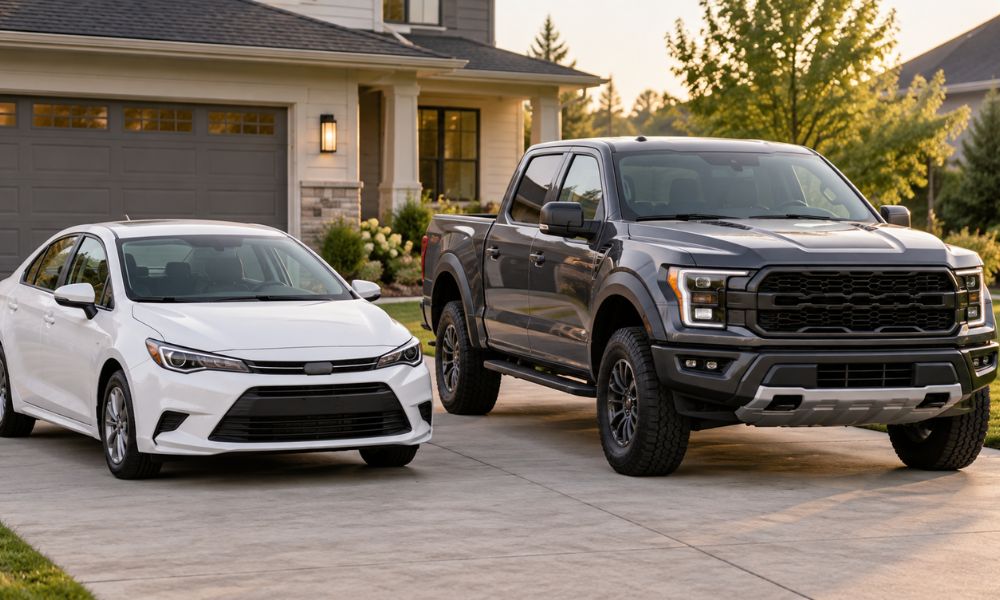
The nearly $1,000 monthly figure is an average. Your choice of vehicle can push the actual number considerably higher or lower.
AAA calculated that a small sedan cost about 55.87 cents per mile to own and operate in 2025. A half-ton pickup came in around 98.54 cents per mile. Choosing the pickup instead of the small sedan could add roughly $6,402 in annual ownership expenses, according to AAA’s ownership-cost comparison.
That is more than $500 a month.
This comparison is far more useful than arguing about whether one brand gives you slightly better gas mileage than another. Moving from one vehicle category to another can have a much larger effect on your budget.
A truck makes perfect financial sense for someone who regularly needs a truck.
Paying thousands of dollars more every year for capability you rarely use is a different calculation.
The Ownership Cost Does Not Stop When the Loan Does
There is another point that gets overlooked when people hear these numbers.
AAA’s estimate assumes five years of ownership. That period contains some of the most expensive depreciation years of a vehicle’s life.
Keeping a reliable car longer can change the economics considerably.
Once the loan is gone, finance charges disappear. Depreciation tends to slow as a vehicle ages. Insurance choices can change. The owner still faces fuel, maintenance, registration, and eventual repairs, but the cost structure is different.
For retirees living mainly on Social Security, those ongoing expenses also put the projected average Social Security raise into perspective: a larger monthly benefit may help cover existing costs without leaving much extra to spend.
That does not mean everyone should keep a car for 15 years. Repair costs and reliability matter.
It does mean replacing a perfectly usable vehicle every few years repeatedly puts you back into the expensive early years of depreciation.
From a household-finance perspective, that cycle deserves much more attention than it gets.
AAA’s Latest Figure Has Already Crossed $1,000
AAA’s 2025 analysis estimated that owning and operating a new vehicle cost $11,577 a year, or $964.78 a month. That is the figure behind the “nearly $1,000 a month” headline.
AAA published a newer estimate in September 2026 of $12,863 a year, or $1,071.92 a month. Be careful about treating that as a simple increase from the 2025 figure, though. AAA changed the study between the two years.
Its 2025 analysis covered 45 models across nine vehicle categories, while the 2026 study covered 34 models across seven categories and incorporated selected EVs and hybrids differently.
AAA itself says the two estimates are not directly comparable. The 2026 figure is therefore best used as updated context rather than evidence that the typical cost of owning a new car increased by a specific percentage in one year.
What both studies do show clearly is that the full cost of new-car ownership sits around the $1,000-a-month mark once depreciation, fuel, insurance, maintenance, financing, taxes, and fees are included.
Think About the Car as a $12,000-a-Year Decision

The number to remember from AAA’s research is not the car payment, but the total annual cost.
A household evaluating a new vehicle should ask what the car costs once depreciation, insurance, fuel, maintenance, financing, registration, and taxes are all included. That number gives a much better picture of what the vehicle is actually doing to the household budget.
AAA’s 2025 estimate came to $11,577. Its updated 2026 analysis is now above $12,800.
Either figure is large enough to change how you should approach the purchase.
A car purchase can also compete with other major plans for the same savings.
If a wedding is one of them, our comparison of wedding costs in New York City and Alaska offers another expense to put beside the vehicle budget.
The most expensive part of owning a new car is not necessarily the expense that gets your attention every month. Depreciation happens quietly. Financing gets hidden inside a manageable-looking payment. Insurance arrives separately. Gas comes in dozens of smaller transactions.
Add everything together, though, and the cost becomes much harder to ignore.
A new car is no longer simply a purchase of roughly $40,000. For many buyers, it is also a commitment to an ownership expense running close to, or now above, $1,000 every month.